K H D B D C M

clearchannel
Mar 15, 2026 · 6 min read
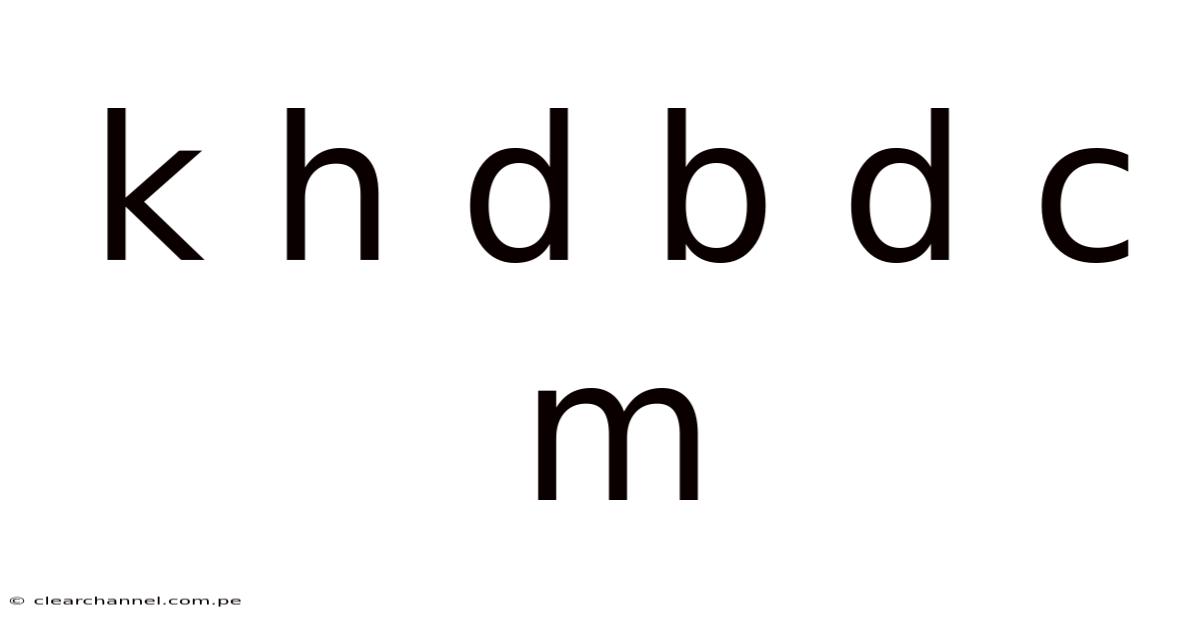
Table of Contents
The Metric System: Understanding k h d b d c m
The metric system is a decimal-based system of measurement used worldwide for scientific and everyday applications. At its core lies a simple yet powerful concept: prefixes that represent powers of ten, making conversions between units straightforward and intuitive. Among these prefixes, the sequence k h d b d c m represents some of the most commonly used units in the metric system.
The prefix sequence k h d b d c m stands for kilo, hecto, deka, base, deci, centi, and milli. Each prefix represents a specific power of ten relative to the base unit. Understanding this sequence is crucial for anyone working with measurements in science, engineering, or daily life.
Starting from the left, kilo (k) represents 1000 times the base unit. This prefix is commonly seen in measurements like kilometers (1000 meters) and kilograms (1000 grams). The next prefix, hecto (h), represents 100 times the base unit, though it's less frequently used in modern applications. Deka (d), also spelled deca, represents 10 times the base unit and is used in measurements like dekaliters.
The base unit (b) is the fundamental measurement without any prefix. For length, this is typically the meter; for mass, it's the gram; and for volume, it's the liter. Moving to the right of the base unit, we encounter the smaller prefixes. Deci (d) represents one-tenth of the base unit, centi (c) represents one-hundredth, and milli (m) represents one-thousandth.
To remember this sequence, many students use mnemonics. One popular example is "King Henry Died By Drinking Chocolate Milk," where each word's first letter corresponds to the prefixes in order. This memory aid helps students recall the sequence and understand the relationships between different metric units.
The beauty of the metric system lies in its consistency across different types of measurements. Whether measuring length, mass, or volume, the same prefixes apply. For instance, a kilometer is 1000 meters, just as a kilogram is 1000 grams. This uniformity makes it easier to convert between units and understand the relationships between different measurements.
In scientific applications, the metric system is indispensable. Scientists worldwide use these units to ensure clear communication and reproducibility of experiments. The decimal nature of the system allows for easy scaling of measurements, which is particularly useful when dealing with extremely large or small quantities.
Understanding the metric system and its prefixes is not just academic; it has practical applications in everyday life. From measuring ingredients for a recipe to calculating distances for a road trip, the ability to work with metric units is a valuable skill. In many countries, including most of Europe and Asia, the metric system is the standard for all measurements, making it essential for international travel and trade.
For students learning about the metric system, practice is key. Converting between units using the k h d b d c m sequence becomes second nature with repetition. For example, to convert 5 kilometers to meters, one simply moves three places to the right in the sequence (kilo to base), multiplying by 1000 to get 5000 meters.
The metric system's logical structure also makes it ideal for teaching mathematical concepts like place value and scientific notation. By understanding how each prefix represents a power of ten, students can more easily grasp these fundamental mathematical ideas.
In conclusion, the sequence k h d b d c m represents a cornerstone of the metric system, providing a logical and consistent way to measure and convert between units. From scientific research to everyday applications, understanding this system opens up a world of precise and universal measurement. As our global community becomes increasingly interconnected, the ability to work with the metric system becomes ever more valuable, making the study of these prefixes an essential part of education and practical knowledge.
The metric system’s origins trace back to the French Revolution, when scientists sought a universal standard based on natural constants. By defining the meter as one ten‑millionth of the distance from the equator to the North Pole, they created a foundation that could be replicated anywhere with comparable precision. This early commitment to reproducibility set the tone for the system’s later expansion into mass, volume, temperature, and even derived units like the newton and joule.
Over time, the system’s simplicity attracted international attention. The 1875 Metre Convention established the International Bureau of Weights and Measures, fostering cooperation among nations to maintain and refine the standards. Today, the General Conference on Weights and Measures (CGMS) meets periodically to update definitions in light of advances in physics—most notably the 2019 redefinition of the kilogram in terms of the Planck constant, which ties the unit to an immutable quantum constant rather than a physical artifact.
Despite its widespread adoption, the metric system coexists with legacy units in a few regions, leading to occasional conversion errors in fields such as aviation, medicine, and engineering. Educational programs that emphasize mental‑math shortcuts—like moving the decimal point according to the k‑h‑d‑b‑d‑c‑m ladder—help mitigate these risks. Interactive tools, such as unit‑conversion apps and augmented‑reality overlays, further reinforce intuitive understanding by letting learners visualize scale changes in real time.
Looking ahead, the metric system’s role in emerging technologies is poised to grow. Quantum computing, nanotechnology, and space exploration all rely on measurements that span many orders of magnitude; a base‑ten framework simplifies the expression of quantities ranging from sub‑atomic diameters to astronomical distances. As global data‑sharing initiatives expand, a common measurement language ensures that algorithms, sensor networks, and machine‑learning models interoperate seamlessly across borders.
In summary, the metric system’s enduring strength lies in its logical, decimal‑based structure and its capacity to evolve alongside scientific progress. By mastering the prefix sequence and appreciating the historical and practical contexts that shaped it, students and professionals alike gain a versatile tool that enhances accuracy, fosters collaboration, and supports innovation in an increasingly interconnected world.
The transition to a fully metric world is not merely a technical matter; it also involves cultural and institutional inertia. In countries where customary units remain entrenched — such as the United States, the United Kingdom for road signage, and several Caribbean nations — shifting public perception requires sustained outreach. Campaigns that link metric fluency to everyday benefits — like easier recipe scaling, clearer medication dosing, and straightforward DIY projects — have shown measurable success when paired with hands‑on workshops in schools and community centers. Moreover, industries that operate across borders, from automotive manufacturing to pharmaceutical supply chains, increasingly mandate metric specifications in contracts, thereby creating economic incentives for broader adoption.
Digital infrastructure further accelerates this shift. Cloud‑based design platforms, IoT sensor networks, and global positioning systems all default to SI units, reducing the cognitive load on engineers who would otherwise need to juggle multiple systems. As artificial‑intelligence models ingest vast datasets from disparate sources, a unified measurement framework minimizes preprocessing errors and enhances model robustness. Looking ahead, the integration of metric standards into emerging protocols — such as those for quantum‑sensor calibration and space‑trajectory planning — will likely become a prerequisite for international collaboration, reinforcing the system’s role as the lingua franca of precision science.
In conclusion, the metric system’s continued relevance hinges on both its intrinsic logical design and the proactive efforts of educators, policymakers, and industry leaders to embed it into daily practice. By fostering familiarity through real‑world applications, leveraging digital tools that default to SI units, and aligning international standards with cutting‑edge technologies, we ensure that the metric system remains a reliable, adaptable foundation for discovery, innovation, and global cooperation well into the future.
Latest Posts
Latest Posts
-
Person Centered Therapist Is Best Described As
Mar 15, 2026
-
The Policy Provision That Entitles The Insurer To Establish Conditions
Mar 15, 2026
-
With Respect To Advection Fog Which Statement Is True
Mar 15, 2026
-
Unity Of Command Means That Every Individual Is Accountable
Mar 15, 2026
-
Burns Associated With Lightning Strikes Are Typically
Mar 15, 2026
Related Post
Thank you for visiting our website which covers about K H D B D C M . We hope the information provided has been useful to you. Feel free to contact us if you have any questions or need further assistance. See you next time and don't miss to bookmark.
