In Social-exchange Theory We Seek To _________ And __________.

clearchannel
Mar 12, 2026 · 11 min read
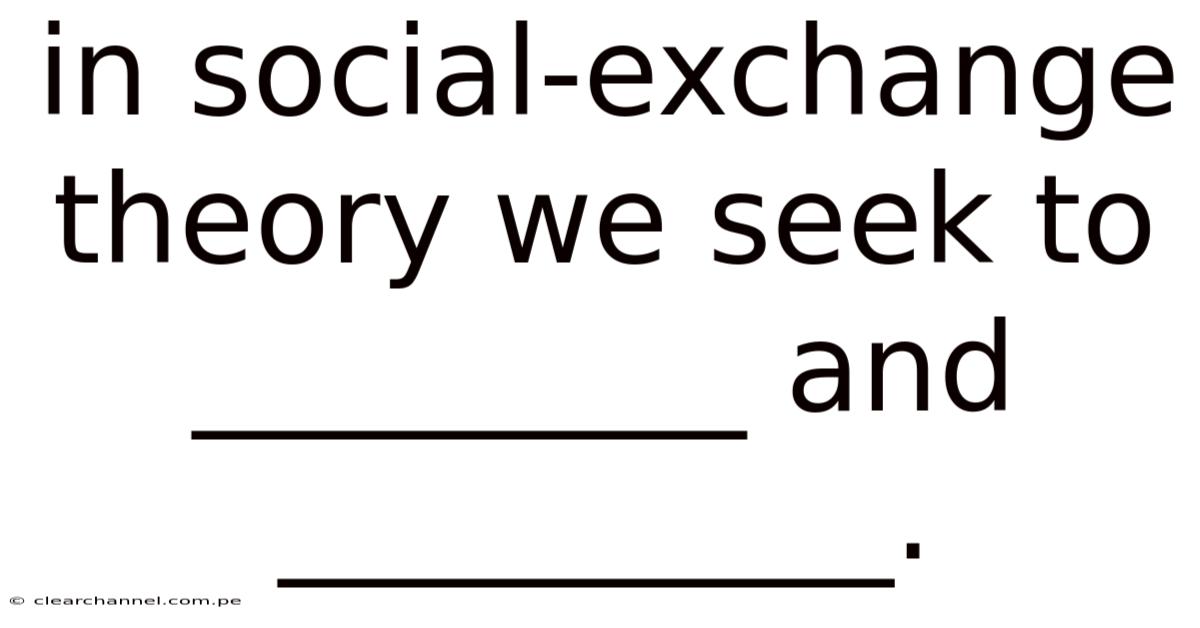
Table of Contents
In social-exchange theorywe seek to maximize rewards and minimize costs. This fundamental principle underpins a powerful framework for understanding human interactions across relationships, workplaces, and societies. Conceived primarily by theorists like George Homans and Peter Blau, social-exchange theory posits that individuals engage in social behavior based on a calculated assessment of the potential benefits and drawbacks. It transforms social dynamics into a series of transactions, where people weigh what they gain against what they give, constantly striving for a favorable balance. This article delves into the core objectives driving social exchange, exploring the mechanisms of reward maximization and cost minimization, and examining how these principles manifest in various contexts.
Introduction: The Transactional Nature of Human Interaction Social-exchange theory offers a compelling lens through which to view human behavior. It suggests that our social world operates much like an economic marketplace. We enter relationships, form friendships, negotiate deals, and navigate workplaces not merely out of affection or duty, but through a continuous, often subconscious, evaluation of costs and benefits. The primary goal driving these interactions is clear: to maximize rewards and minimize costs. This pursuit shapes our choices, influences our satisfaction, and ultimately determines the stability and longevity of our social bonds. Understanding this transactional drive is crucial for grasping the underlying logic of human connection and conflict.
Steps: The Mechanics of Exchange and Evaluation Applying social-exchange theory involves a series of steps individuals unconsciously or consciously follow:
- Cost-Benefit Assessment: Before engaging in any interaction, individuals estimate the potential costs (time, effort, emotional investment, potential for rejection) and benefits (emotional support, companionship, status, material gain, information).
- Comparison Level (CL): Individuals compare the current relationship or interaction against their internal benchmark – the CL. This CL represents the minimum level of rewards they feel they deserve based on past experiences and expectations.
- Comparison Level for Alternatives (CLalt): Simultaneously, individuals evaluate the potential rewards and costs of leaving the current situation for a different option. This CLalt influences their decision to stay or seek alternatives.
- Reward Maximization: The core drive is to maximize rewards. Individuals seek relationships and behaviors that offer the highest possible net gain in positive outcomes – love, respect, security, pleasure, or tangible assets. They are motivated by the prospect of gaining more than they give.
- Cost Minimization: Equally important is the drive to minimize costs. This involves avoiding unnecessary pain, effort, or negative outcomes. Individuals strive to reduce the burdens associated with relationships, such as conflict, dependency, or unmet expectations. The ideal scenario is achieving high rewards with minimal costs.
- Outcome Calculation: The net outcome (Rewards - Costs) determines satisfaction. A positive outcome (more rewards than costs) generally leads to satisfaction and commitment. A negative outcome (more costs than rewards) leads to dissatisfaction and a desire to alter the relationship or exit it.
- Behavioral Adjustment: Based on the outcome and comparison levels, individuals may adjust their behavior – increasing efforts to gain more rewards, decreasing efforts to reduce costs, or seeking new partners/alternatives.
Scientific Explanation: The Foundations and Implications The theory draws heavily on behaviorist principles (like operant conditioning) and economic concepts. It views social behavior as learned through reinforcement – rewards strengthen behaviors, while costs or punishments discourage them. Key concepts include:
- Equity Theory: A related concept emphasizing fairness. Individuals compare their input (costs) and output (rewards) to another person's. Perceived inequity (feeling over-benefited or under-benefited) leads to distress and motivates efforts to restore balance.
- Comparison Levels: These internal standards are shaped by past experiences (history) and societal norms (culture). They act as filters, determining what individuals perceive as fair and rewarding.
- Power Dynamics: Relationships where one party consistently experiences more costs than rewards often indicate an imbalance of power, potentially leading to exploitation or dependency.
- Relationship Stability: Relationships are most stable when the rewards consistently outweigh the costs and when both parties perceive the relationship as equitable compared to their alternatives. If costs consistently outweigh rewards, or if a better alternative (CLalt) is perceived, the relationship is likely to dissolve.
FAQ: Clarifying Common Questions
- Q: Is social-exchange theory only about romantic relationships? A: No. While often applied to romantic partnerships, the theory is incredibly broad. It explains dynamics in friendships, family relationships, workplace interactions, customer loyalty, online communities, and even political alliances. Any social interaction involving potential costs and rewards is a candidate.
- Q: Does this mean people are purely selfish? A: Not necessarily. While the theory focuses on individual calculation, it acknowledges that people also value fairness and equity (equity theory). Altruism can occur if the perceived rewards (e.g., feeling good, social approval) outweigh the costs. The "selfishness" is more about maximizing perceived net benefit.
- Q: How conscious is this process? A: It operates on a spectrum. Many cost-benefit assessments are subconscious and automatic, driven by evolutionary and learned patterns. However, individuals can become more aware of these calculations, especially when evaluating significant life choices or relationship dissatisfaction.
- Q: Can relationships be successful if costs are high? A: Yes, if the perceived rewards are sufficiently high and the costs are deemed worthwhile (e.g., investing heavily in a child's education for future rewards). The key is the perceived net benefit. High costs only become problematic if rewards don't justify them.
- Q: What happens when costs outweigh rewards? A: Dissatisfaction, resentment, withdrawal of effort, and potentially relationship termination are common outcomes. Individuals may seek to renegotiate terms, leave the relationship, or reduce their own costs (e.g., by setting boundaries).
Conclusion: The Enduring Relevance of Exchange Social-exchange theory provides a fundamental framework for understanding the transactional nature of human social life. It powerfully explains why we form and maintain relationships, why we sometimes feel
...taken advantage of, and why certain relationships thrive while others falter. It's not a cynical view of human interaction, but rather a realistic one, acknowledging that individuals are constantly evaluating the balance of give and take.
The theory's strength lies in its adaptability. It's not a rigid formula, but a flexible lens through which to examine a vast array of social dynamics. Understanding the underlying cost-benefit calculations can empower us to make more informed choices about our relationships, to communicate our needs more effectively, and to cultivate connections that are mutually beneficial and sustainable.
Furthermore, recognizing the influence of perceived fairness (equity theory) allows us to proactively address imbalances and foster stronger, more resilient bonds. By striving for relationships where both parties feel valued and respected, and where the rewards consistently outweigh the costs, we can navigate the complexities of human connection with greater awareness and success. Social-exchange theory isn't just an academic concept; it's a practical tool for building healthier, more fulfilling relationships in all aspects of our lives. It reminds us that even in the most intimate connections, a degree of conscious evaluation and equitable contribution is key to long-term satisfaction and mutual well-being.
Continuingthe exploration of social-exchange theory, its practical implications extend far beyond academic discourse, offering valuable insights for navigating the complexities of modern relationships. While the theory emphasizes the perceived balance of rewards and costs, it's crucial to acknowledge the significant role of emotion, commitment, and long-term investment that often transcends purely rational calculation. Relationships frequently involve investments (time, resources, emotional energy) that may not yield immediate or tangible rewards, yet are sustained by deep-seated bonds, shared history, and future-oriented goals. This highlights the theory's adaptability – it doesn't negate the power of love or loyalty but provides a framework to understand the underlying dynamics that support or challenge these profound connections.
Furthermore, the theory's lens is particularly illuminating in understanding power dynamics and inequality within relationships. When one partner consistently perceives a significant imbalance, where their costs are high and rewards low, it can lead to profound dissatisfaction and resentment, as outlined in the previous Q&A. This perceived inequity can manifest in various ways: emotional withdrawal, reduced effort, seeking fulfillment elsewhere, or even the dissolution of the relationship. Recognizing these patterns allows individuals and couples to proactively address imbalances. Open communication about needs, expectations, and contributions becomes essential. Negotiating new terms, setting clearer boundaries, or seeking external support (like couples counseling) can help restore a more equitable exchange, fostering a healthier dynamic where both partners feel valued and their contributions are acknowledged.
In contemporary contexts, the theory also sheds light on the evolving nature of relationships, including those formed and maintained primarily online. Digital interactions introduce new dimensions to the cost-benefit analysis: the ease of communication versus potential superficiality, the curated nature of online personas versus authentic connection, and the unique costs/benefits of long-distance relationships facilitated by technology. Understanding the exchange processes at play can help individuals navigate these modern landscapes more consciously, discerning genuine connection from transactional interactions and making choices aligned with their deeper needs and values.
Ultimately, social-exchange theory remains a powerful, enduring tool. It moves beyond simplistic notions of relationships as purely transactional, instead offering a nuanced understanding of the constant, often subconscious, evaluations that underpin human connection. By fostering greater awareness of these underlying calculations – the perceived rewards, costs, and fairness – individuals are better equipped to build relationships characterized by mutual respect, sustainable effort, and genuine satisfaction. It empowers us to communicate our needs effectively, recognize when adjustments are necessary, and cultivate bonds where the rewards consistently outweigh the costs, leading to more resilient, fulfilling, and mutually beneficial partnerships across all facets of life.
Conclusion: The Enduring Relevance of Exchange
Social-exchange theory provides a fundamental framework for understanding the transactional nature of human social life. It powerfully explains why we form and maintain relationships, why we sometimes feel taken advantage of, and why certain relationships thrive while others falter. It's not a cynical view of human interaction, but rather a realistic one, acknowledging that individuals are constantly evaluating the balance of give and take.
The theory's strength lies in its adaptability. It's not a rigid formula, but a flexible lens through which to examine a vast array of social dynamics. Understanding the underlying cost-benefit calculations can empower us to make more informed choices about our relationships, to communicate our needs more effectively, and to cultivate connections that are mutually beneficial and sustainable.
Furthermore, recognizing the influence of perceived fairness (equity theory) allows us to proactively address imbalances and foster stronger, more resilient bonds. By striving for relationships where both parties feel valued and respected, and where the rewards consistently outweigh the costs, we can navigate the complexities of human connection with greater awareness and success. Social-exchange theory isn't just an academic
Social-exchange theory isn't just an academic concept; it's a practical guide for navigating the intricate web of human relationships. Consider the implications for professional settings. Employees, for instance, weigh the rewards of a job – salary, benefits, recognition, opportunities for growth – against the costs – workload, stress, commute, potential for conflict. When the perceived ratio is unfavorable, dissatisfaction and turnover are likely. Similarly, in volunteer organizations, understanding the exchange process can help leaders cultivate a culture of appreciation and recognition, ensuring volunteers feel their contributions are valued and sustained.
The theory also sheds light on the dynamics of online communities. While these spaces often promise connection and belonging, they can also be rife with superficial interactions and a relentless pursuit of validation. Individuals may invest significant time and emotional energy into crafting a perfect online persona, seeking likes and followers as a form of social reward. However, if the perceived costs – the time spent, the potential for negative feedback, the pressure to maintain an image – outweigh the rewards, the relationship with the platform, and even with other users, can become draining and ultimately unsustainable. This highlights the importance of mindful engagement and prioritizing genuine connections over fleeting digital validation.
Looking ahead, the increasing integration of artificial intelligence into our social lives will further complicate the application of social-exchange theory. As we interact with AI companions and virtual assistants, the traditional notions of reciprocity and fairness will need to be re-evaluated. Will we expect emotional support from AI, and how will we define the “costs” of relying on a non-human entity? The theory provides a valuable starting point for exploring these emerging ethical and social dilemmas.
Ultimately, social-exchange theory isn't about reducing human relationships to mere transactions. It’s about recognizing the inherent human tendency to evaluate our interactions and seeking a balance that promotes well-being and fulfillment. By understanding the principles of reward, cost, and fairness, we can move beyond reactive responses to relationship challenges and proactively cultivate connections that are both meaningful and sustainable, enriching our lives and fostering a more equitable and satisfying social landscape. It’s a framework for conscious connection, empowering us to build a world where relationships are not just endured, but actively nurtured and celebrated.
Latest Posts
Latest Posts
-
Allocating Common Fixed Expenses To Business Segments
Mar 12, 2026
-
K Is Looking To Purchase Renewable Term Insurance
Mar 12, 2026
-
Law Enforcement Personnel Request Your Assistance
Mar 12, 2026
-
College Physic 1 Khalid Bukhari Past Exam
Mar 12, 2026
-
Common French Words Used In English
Mar 12, 2026
Related Post
Thank you for visiting our website which covers about In Social-exchange Theory We Seek To _________ And __________. . We hope the information provided has been useful to you. Feel free to contact us if you have any questions or need further assistance. See you next time and don't miss to bookmark.
