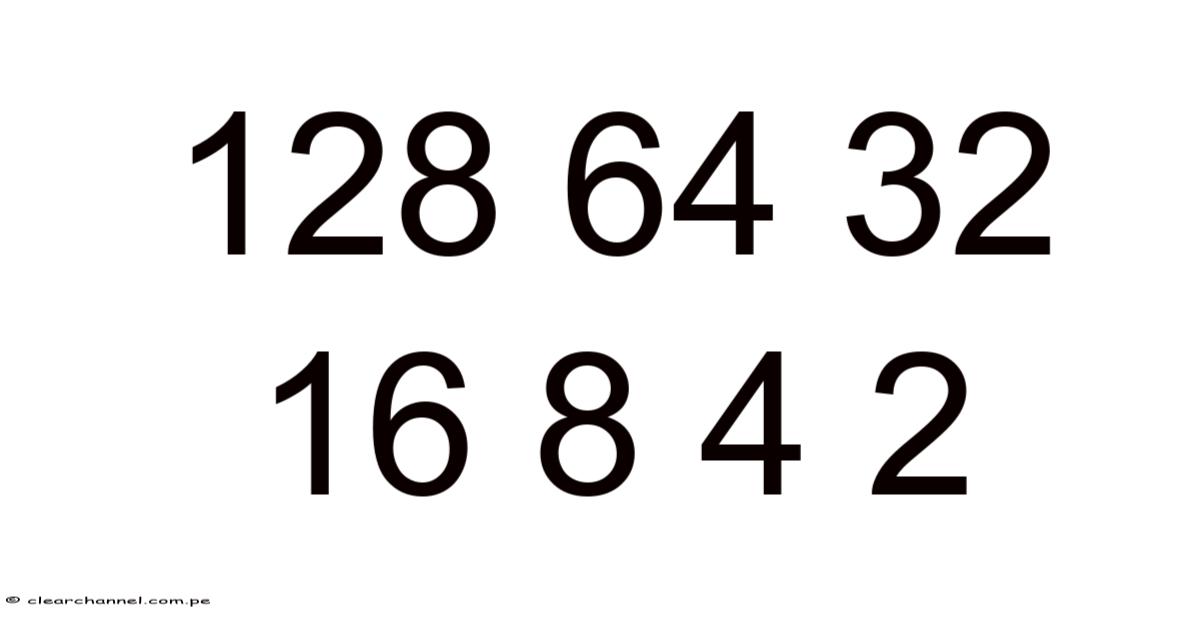
12864 32 16 8 4 2: The Power of Binary Sequences in Technology and Mathematics
The sequence 128, 64, 32, 16, 8, 4, 2 is more than a simple list of numbers. It represents a fundamental pattern rooted in binary mathematics, a cornerstone of modern computing and digital systems. Each number in this sequence is a power of two, decreasing by half with each step. That said, this progression is not arbitrary; it reflects the binary system’s structure, where each position corresponds to a power of two. Because of that, understanding this sequence is crucial for grasping how data is processed, stored, and transmitted in technology. Whether you’re a student, a developer, or someone curious about the mechanics of digital devices, this sequence holds significant relevance.
The Binary Foundation of the Sequence
At its core, the sequence 128, 64, 32, 16, 8, 4, 2 is a direct representation of binary values. Take this case: the binary number 10000000 equals 128 in decimal, while 01000000 equals 64. So every bit of data, from a single character to complex algorithms, is stored and processed using binary digits (0s and 1s). In real terms, in binary, each digit represents a power of two, starting from 2⁰ (1) up to 2⁷ (128). To give you an idea, the number 128 is 2⁷, 64 is 2⁶, and so on. This pattern is essential in computer science because binary is the language of computers. Which means the sequence 128, 64, 32, 16, 8, 4, 2 is often used to explain how binary numbers are constructed. This relationship between binary and decimal systems is foundational to understanding how computers interpret and manipulate data.
Applications in Computing and Data Storage
The sequence 128, 64, 32, 16, 8, 4, 2 is frequently encountered in computing, particularly in memory allocation and data transfer rates. Still, in memory management, these numbers often represent block sizes or cache levels. That said, similarly, in networking, data transfer rates are sometimes measured in bits per second (bps), where these numbers could denote specific rates. As an example, a computer’s cache might use 64KB or 128KB blocks to store frequently accessed data, optimizing speed and efficiency. A 128 bps connection, for instance, would transmit 128 bits of data per second. While modern networks operate at much higher speeds, the sequence serves as a simplified example to illustrate how data is broken down into manageable units.
Most guides skip this. Don't.
Another practical application is in file formats and compression. To give you an idea, a 128-pixel image might be processed in 64-pixel segments, with further divisions into 32, 16, and so on. Because of that, many digital files, such as images or audio, are divided into chunks that align with powers of two. This alignment ensures compatibility with hardware and software that process data in binary. This hierarchical approach simplifies processing and reduces computational complexity.
And yeah — that's actually more nuanced than it sounds.
The Role of the Sequence in Algorithms and Problem-Solving
In algorithm design, the sequence 128, 64, 32, 16, 8, 4, 2 can be used to demonstrate divide-and-conquer strategies. Algorithms that break problems into smaller subproblems often rely on powers of two for efficiency. Here's a good example: binary search algorithms divide a sorted list into halves repeatedly, using this sequence to determine the midpoint at each step. In practice, similarly, in cryptography, certain encryption methods use binary operations that align with this sequence to enhance security. The sequence’s predictability and mathematical properties make it a valuable tool for optimizing computational tasks.
On top of that, the sequence is used in educational settings to teach concepts like recursion and exponential growth. By starting with 128 and halving each time, students can visualize how exponential decay works. Even so, this is particularly useful in fields like biology or finance, where exponential patterns are common. To give you an idea, understanding how a population or investment grows (or shrinks) can be modeled using similar principles.
The Sequence in Everyday Technology
Beyond technical applications, the sequence 128, 64, 32, 16, 8, 4, 2 appears in everyday technology. Here's a good example: smartphone storage capacities often use these numbers. These numbers are not just arbitrary; they reflect the binary nature of digital systems. Because of that, a 128GB phone might allocate 64GB for user data, 32GB for system files, and so on. Even so, similarly, audio equipment might support bit depths of 16 or 32 bits, which relate to the sequence’s values. Even in gaming, frame rates or resolution settings might be based on powers of two, ensuring compatibility with hardware that processes data in binary The details matter here..
Another example is in the design of user interfaces. Many software applications use grid systems based on powers of two to ensure responsiveness across different screen sizes. A layout might scale by 128px, 64
Another domain where this sequence is indispensable is in computer networking and data transmission. Network subnet masks, which define the range of IP addresses in a network, are commonly expressed in dotted-decimal notation using values like 255.255.255.Still, 128, 255. 255.Practically speaking, 255. Practically speaking, 192, or 255. 255.255.224—each corresponding to a block size derived from powers of two (128, 64, 32, etc.). And this allows network administrators to efficiently divide large networks into smaller, manageable subnets. Similarly, packet size standards in data communication, such as the 1500-byte Ethernet MTU (Maximum Transmission Unit), are often broken down into smaller chunks aligned with powers of two for processing by hardware buffers and network stacks, minimizing overhead and fragmentation The details matter here..
In memory management and hardware design, the sequence governs how memory is allocated and addressed. In real terms, rAM modules, cache lines, and virtual memory pages are typically sized in powers of two—such as 4KB, 8KB, or 64KB—because it simplifies the binary arithmetic used by memory controllers and operating systems. This alignment reduces wasted space (known as "memory fragmentation") and ensures that data can be retrieved in whole, contiguous blocks, significantly speeding up access times. Even the design of CPU instruction sets and cache architectures leverages this sequence to optimize data flow and parallel processing Simple as that..
The official docs gloss over this. That's a mistake Most people skip this — try not to..
The sequence also appears in more abstract computational theories. g.In the study of algorithms and data structures, the concept of a "binary hierarchy" underpins balanced trees like binary heaps and binary search trees, where each level represents a doubling or halving of capacity. This principle is crucial for maintaining logarithmic time complexity in operations like insertion, deletion, and search. To build on this, in fields like signal processing and data compression (e., JPEG, MP3), transforms such as the Fast Fourier Transform (FFT) recursively divide data into even and odd samples—a process that inherently follows a halving sequence, enabling efficient computation Easy to understand, harder to ignore..
The bottom line: the sequence 128, 64, 32, 16, 8, 4, 2 is far more than a simple numeric pattern; it is a fundamental expression of binary logic embedded in the fabric of digital systems. From the microscopic layout of transistors in a chip to the global infrastructure of the internet, its influence arises from the unparalleled efficiency and elegance of powers of two in managing complexity, optimizing resources, and enabling scalable design. It serves as a quiet but powerful reminder that the digital world, for all its apparent sophistication, is built upon a foundation of simple, repeating dualities—a rhythm of halving and doubling that mirrors the very logic of computation itself.
Not the most exciting part, but easily the most useful.
This same principle extends into the realm of human-computer interaction, where interface design and user experience are shaped by the binary hierarchy in ways that are often invisible to the end user. Display resolutions, for instance, frequently follow standards rooted in powers of two—800×600, 1024×768, 1920×1080—because these dimensions map cleanly onto the pixel grids of graphics processing units. Font rendering engines, meanwhile, rely on hinting tables that use binary subdivision to ensure glyphs remain crisp at any size, from the tiniest icon to the largest billboard That's the whole idea..
Even in modern cloud computing and distributed systems, the halving sequence reasserts itself. This leads to auto-scaling policies in containerized environments often trigger at thresholds that are multiples or divisors of powers of two, because load balancers and service meshes are engineered to distribute traffic across node counts that optimize hash distribution and reduce network latency. Database sharding strategies frequently begin with 128 shards or 64 partitions, then subdivide as data grows, because partitioning along binary boundaries guarantees uniform key distribution and predictable query performance. Microservices architectures, too, inherit this logic: communication channels, thread pools, and connection limits are routinely configured in powers of two to balance throughput against contention and memory overhead Most people skip this — try not to..
Perhaps the most compelling illustration of the sequence's reach comes from quantum computing, an emerging paradigm that operates on an even more radical binary foundation. Qubit registers, quantum gates, and error-correction codes all rely on the structure of power-of-two state spaces. A register of n qubits represents 2^n possible states simultaneously, and algorithms such as Shor's factoring method exploit this exponential scaling to solve problems intractable for classical machines. Here, the sequence 128, 64, 32, 16, 8, 4, 2 ceases to be merely a convenience of engineering and becomes a bridge between classical digital design and the probabilistic logic of quantum systems—suggesting that the halving and doubling rhythm is not merely a human convention but a deep constraint imposed by the mathematics of information itself And it works..
Quick note before moving on Small thing, real impact..
All in all, the recurring appearance of the sequence 128, 64, 32, 16, 8, 4, 2 across networking, memory architecture, algorithm design, signal processing, interface standards, cloud infrastructure, and quantum computing underscores a single, unifying truth: the digital world is organized by the logic of two. But this is not a coincidence born of habit but a reflection of the most efficient way known to arrange, process, and transmit information—where every halving sharpens precision and every doubling expands capability. Which means whether engineers are subnetting an IP address space, allocating a memory page, balancing a distributed database, or programming a quantum register, they return again and again to the same binary scaffolding. The sequence endures because it encodes the fundamental rhythm of computation, a quiet pulse that drives the entire edifice of modern technology from the ground up.
Not obvious, but once you see it — you'll see it everywhere.
